
Kaiping ultrasonic cleaning machine informs how to select cleaning solution
Do not use flammable or low flash point solutions when using cleaning solutions first. The energy released by the cavitation effect is converted into thermal and kinetic energy and generates high temperatures in the solution, which is very dangerous for flammable liquids. Acidic cleaning solutions and bleaching agents should usually be avoided from use as they can damage stainless steel tanks or cause harm; But they can be used in direct cleaning processes, such as using large beakers as direct cleaning containers. There are two types of solvent cleaning agents: cyclic and non environmentally friendly. Common environmentally friendly cleaning agents include hydrocarbon cleaning agents, which have different evaporation rates and are safe, but they are prone to catching fire. Common non environmentally friendly solvent cleaning agents include trichloroethylene and dichloromethane, which evaporate quickly and are unsafe but do not ignite. There are many types of water-based cleaning agents, which can be divided into low foaming cleaning agents and foaming cleaning agents according to their application methods. According to their properties, they can be classified as alkaline, neutral, and acidic. Alkaline oil removal is the strongest and has good universality; Neutral oil removal is poor, with the best universality; Acidic oil removal is the worst, but it has other uses and good universality.
When selecting cleaning solution, the following three factors should be considered:
1. Cleaning efficiency: When selecting the most useful cleaning solvent, it is necessary to conduct experiments. If ultrasound is introduced into the existing cleaning process, the solvent used generally does not need to be changed;
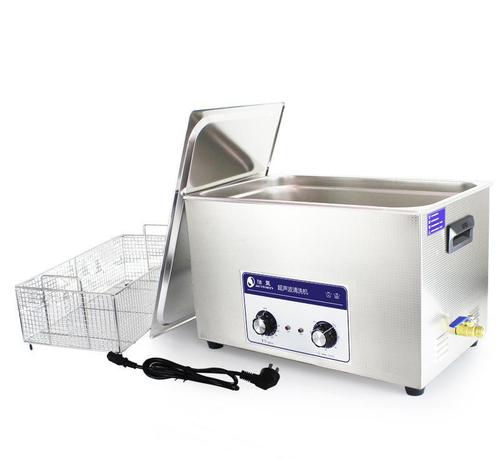
2. Easy operation: The liquid used should be safe, non-toxic, easy to operate, and have a long service life;
3. Cost: The cost of using the cheapest cleaning solvent is not necessarily the lowest. It is necessary to consider factors such as solvent cleaning efficiency, safety, how many workpieces can be cleaned with a certain amount of solvent, and the highest utilization rate in application. Of course, the selected cleaning solvent must achieve the desired cleaning effect and be compatible with the workpiece being cleaned. Water is the most common cleaning solution, so the system using water-based solutions is simple to operate, has low operating costs, and is widely used. However, for certain materials and dust that are not suitable for aqueous solutions, there are still many solvents available for selection. Different cleaning solutions require distinct cleaning systems
Water based system: usually composed of an open groove in which the workpiece is immersed. The complex system consists of multiple tanks and is equipped with a circulating filtration system, flushing tank, drying tank, and other accessories.
Article source: Kaiping ultrasonic cleaning machine http://www.kpzfcsb.com/
-
04-01
Jiangmen Ultrasonic Cleaning Machine: What are the reasons for poor cleaning effect?
People originally use ultrasonic cleaning machines for convenience, and if ultrasonic cleaning is not clean, they will definitely feel sad in their hearts. What is the reason for the uncleanliness of
-
01-04
Cleaning process of ultrasonic cleaning machine
Cleaning processSelect a reasonable ultrasonic cleaning machine process based on the characteristics and contamination of the workpiece.4. How to choose between manual and semi-automaticManual operati
-
12-16
Instructions for using Jiangmen ultrasonic cleaning machine
1. Device ultrasonic cleaning machinePlease refer to the instruction manual of the ultrasonic cleaning machine to connect the temperature control sensor signal line, ultrasonic drive line, heater cont
-
12-10
Cavitation phenomenon of Jiangmen ultrasonic cleaning machine
Magical cavitation phenomenonWhen it comes to ultrasonic cleaning, some people may think that it is the use of high-frequency vibration of ultrasonic waves to destroy dust and dirt. Actually, ultrason