
What are the process flows and working procedures of Kaiping ultrasonic cleaning machine
It mainly consists of two parts: an ultrasonic cleaning tank and an ultrasonic generator. The advantages are: good ultrasonic cleaning effect and simple operation.
technological process
1. Cleaning after grinding
Grinding is an important process in the production of optical glass that determines its processing efficiency and surface quality (appearance and accuracy). The primary pollutants in the grinding process are grinding powder and asphalt, and a few companies may have paint chips in their processing. The types of grinding powders vary among them, generally consisting of alkali metal oxides mainly composed of cerium dioxide. Select different types of grinding powder based on the material and grinding accuracy of the lens. The asphalt used in the grinding process has a protective effect to prevent the polished mirror surface from being scratched or corroded. After grinding, there are roughly two types: one primarily uses organic solvent cleaning agents, and the other primarily uses semi water-based cleaning agents.
2. Cleaning before coating
The primary pollutants cleaned before coating are core oil (also known as edge grinding oil, core positioning, core sampling, referring to the process used to obtain a regular radius and core accuracy), fingerprints, dust, etc. Because the coating process has extremely strict requirements for the cleanliness of lenses, the selection of cleaning agents is very important. When considering the cleaning ability of a certain cleaning agent, one should also take into account its corrosiveness and other issues.
The cleaning before coating is generally carried out using the same methods as cleaning after grinding, including solvent cleaning and semi water-based cleaning. The process flow and types of chemical agents used are as described earlier.
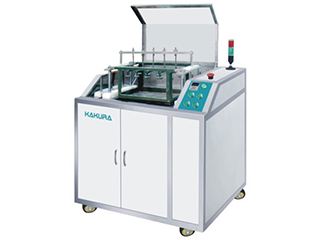
3. Cleaning after coating
Generally, it includes pre ink cleaning, pre bonding cleaning, and pre assembly cleaning. The direct pre bonding cleaning (bonding refers to the process of bonding two lenses into a regular shape with photosensitive adhesive to meet the needs of one-time processing or to manufacture a more special curvature and transmittance) requires the strictest requirements. The pollutants that need to be cleaned before joining are mainly a mixture of dust, fingerprints, etc. The cleaning difficulty is not high, but there are very high requirements for the cleanliness of the lens surface, and the cleaning method is the same as the previous two cleaning processes.
Ultrasonic cleaning machines produce noise when their operating frequency is very low (within the range of human hearing). When the frequency is below 20kHz, the working noise not only becomes very loud, but may also exceed the safety noise limits stipulated by the Occupational Safety and Health Law or other regulations. In applications that require high-power dust removal without considering damage to the surface of the workpiece, lower cleaning frequencies ranging from 20kHz to 30kHz are usually selected. The cleaning frequency within this frequency range is often used to clean large, heavy parts or workpieces made of high-density materials.
Low frequency is usually used to clean smaller and finer parts, or to remove fine particles. High frequency is also used for applications where the surface of the workpiece is not allowed to be damaged. The use of high frequency can improve the cleaning function in several aspects. As the frequency increases, the number of cavitation bubbles increases linearly, and then more and more dense shock waves occur, allowing them to enter smaller gaps. If the power remains constant, the cavitation bubbles will become smaller and the energy released will correspondingly decrease, effectively reducing the damage to the surface of the workpiece. Another advantage of high frequency is that it reduces the viscous boundary layer (Bernoulli effect), allowing ultrasound to "discover" extremely fine particles. This situation is similar to seeing small stones at the bottom of a stream when the water level drops.
Work process
Regarding "ultrasonic cleaning": Ultrasonic cleaning is the direct and direct effect of using the cavitation effect, acceleration effect, and direct flow effect of ultrasonic waves in liquid to disperse, emulsify, and peel off the dirt layer and achieve the cleaning intention. In the ultrasonic cleaning machine used, cavitation effect and direct flow effect are more commonly used.
Cavitation effect
The cavitation effect refers to the high-frequency transformation method of ultrasonic waves transmitting through a liquid at a rate of more than 20000 times per second through the interaction of compression force and pressure reduction. During the pressure reduction effect, the phenomenon of vacuum nucleus bubbles occurs in the liquid. During the tightening force effect, the vacuum nucleus bubbles are crushed by pressure and generate strong impact force, thereby peeling off the dust and dirt on the surface of the cleaned object, and then achieving the intention of fine cleaning.
In the ultrasonic cleaning process, the visible bubbles are not vacuum core bubbles, but air bubbles, which suppress the cavitation effect and reduce the cleaning efficiency. As long as the air bubbles in the liquid are completely removed, the vacuum core group bubble with cavitation effect can achieve the best effect.
Direct flow
The phenomenon of ultrasonic waves moving along the direction of sound transmission in liquid is called straight flow. When the sound wave intensity is 0.5W/cm2, the naked eye can see a straight flow that moves perpendicular to the vibration surface, with a flow velocity of about 10cm/s. Through this direct flow, the fine oil and dirt on the surface of the cleaned object are mixed, and the cleaning solution on the surface of the dirt also undergoes convection. The solution that dissolves the dirt is mixed with the new liquid, which accelerates the dissolution rate and has a great effect on the transportation of the dirt.
acceleration
The acceleration caused by the propulsion of liquid particles. Regarding high-frequency ultrasonic cleaning machines, the cavitation effect is not very obvious. At this time, the cleaning mainly relies on the acceleration collision particles under the ultrasonic effect of liquid particles to perform ultra-fine cleaning of the dirt.
Article source: Kaiping ultrasonic cleaning machine http://www.kpzfcsb.com/
-
04-01
Jiangmen Ultrasonic Cleaning Machine: What are the reasons for poor cleaning effect?
People originally use ultrasonic cleaning machines for convenience, and if ultrasonic cleaning is not clean, they will definitely feel sad in their hearts. What is the reason for the uncleanliness of
-
01-04
Cleaning process of ultrasonic cleaning machine
Cleaning processSelect a reasonable ultrasonic cleaning machine process based on the characteristics and contamination of the workpiece.4. How to choose between manual and semi-automaticManual operati
-
12-16
Instructions for using Jiangmen ultrasonic cleaning machine
1. Device ultrasonic cleaning machinePlease refer to the instruction manual of the ultrasonic cleaning machine to connect the temperature control sensor signal line, ultrasonic drive line, heater cont
-
12-10
Cavitation phenomenon of Jiangmen ultrasonic cleaning machine
Magical cavitation phenomenonWhen it comes to ultrasonic cleaning, some people may think that it is the use of high-frequency vibration of ultrasonic waves to destroy dust and dirt. Actually, ultrason