
How to calculate the operating frequency of Jiangmen ultrasonic cleaning machine
Ultrasonic waves are sound waves with frequencies higher than 20000 hertz. It has good directionality, strong penetration power, and is easy to obtain relatively concentrated sound energy. Can be used for distance measurement, speed measurement, ultrasonic cleaning machine, welding, crushing, sterilization, etc. There are many applications in medicine, military, industry, and agriculture. The reason why ultrasound is named is because its low frequency is approximately equal to the upper limit of human hearing.
How to calculate the frequency of ultrasound? The propagation speed of sound waves in solids is also different. Through repeated measurements, it was found that there are two ways in which sound waves propagate in solids: longitudinal waves and transverse waves, which have different wave velocities. Taking stainless steel as an example, the longitudinal wave velocity is 5790m/s and the transverse wave velocity is 3100m/s. Make stainless steel into strips with a longitudinal wave velocity of 5000 meters per second.
In the cleaning of ultrasonic cleaning machines, the first step is to correctly select the frequency of the ultrasonic cleaning machine. The frequency of ultrasonic cleaning machine is a decisive process parameter as it directly affects cavitation. The lower the ultrasonic cleaning frequency, the stronger the ultrasonic cavitation, and the better the cleaning effect, but the louder the noise. So the frequency of the ultrasonic cleaning machine commonly used is around 20kHz, and the cavitation cleaning effect is better at this time.
For parts with high surface finish and small hole diameter, it is recommended to use high-frequency ultrasonic cleaning machines with shorter wavelengths and more concentrated energy. But high-frequency ultrasonic oscillation attenuates greatly in the cleaning solution, has a short action interval, and weak cavitation intensity, so the cleaning power is low. In addition, due to the directional shadows generated by high-frequency ultrasonic cleaning machines, some parts of the cleaned parts may not be able to be cleaned.
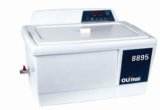
When cleaning the machine, there is no frequency tracking of the ultrasonic cleaning machine. It is often necessary to adjust the frequency adjustment knob of the ultrasonic cleaning machine generator so that the frequency of its output signal is always consistent with the natural frequency of the transducer, and then achieve the strongest cavitation and optimal cleaning effect.
In metals, beryllium is a master of sound communication. The longitudinal wave velocity of sound waves in beryllium rods can reach 12890 m/s, which is 38 times the atmospheric sound transmission velocity. Polyethylene plastic has poor sound transmission ability. The longitudinal wave velocity of polyethylene rod is only 920 meters per second, which is not as fast as the speed of sound in water. Soft rubber is elastic, so sound waves cannot move inside. Its speed is only 30-50 meters per second, slower than the speed of sound in air. Speed divided by frequency equals wavelength.
When ultrasonic wave acts on the liquid, each foam break in the liquid will produce huge shock wave energy, which is equivalent to hundreds of degrees of high temperature and thousands of atmospheres of pressure in an instant. This phenomenon is called "cavitation effect". Ultrasonic wave is used to clean the internal and external surfaces of the workpiece due to the breaking of liquid foam. Ultrasonic waves pass through the liquid, causing the liquid and cleaning tank to oscillate together at ultrasonic frequencies. When the liquid oscillates with the cleaning tank, it has its own natural frequency. This oscillation frequency is the frequency of sound waves, so what people hear is buzzing sound.
Article source: Jiangmen Ultrasonic Cleaning Machine http://www.kpzfcsb.com/
-
04-01
Jiangmen Ultrasonic Cleaning Machine: What are the reasons for poor cleaning effect?
People originally use ultrasonic cleaning machines for convenience, and if ultrasonic cleaning is not clean, they will definitely feel sad in their hearts. What is the reason for the uncleanliness of
-
01-04
Cleaning process of ultrasonic cleaning machine
Cleaning processSelect a reasonable ultrasonic cleaning machine process based on the characteristics and contamination of the workpiece.4. How to choose between manual and semi-automaticManual operati
-
12-16
Instructions for using Jiangmen ultrasonic cleaning machine
1. Device ultrasonic cleaning machinePlease refer to the instruction manual of the ultrasonic cleaning machine to connect the temperature control sensor signal line, ultrasonic drive line, heater cont
-
12-10
Cavitation phenomenon of Jiangmen ultrasonic cleaning machine
Magical cavitation phenomenonWhen it comes to ultrasonic cleaning, some people may think that it is the use of high-frequency vibration of ultrasonic waves to destroy dust and dirt. Actually, ultrason