
Common problems and solutions of heat exchanger in Kaiping ultrasonic cleaning machine
Nowadays, with the rapid development of the pharmaceutical industry, ultrasonic cleaning machines are playing an increasingly important role, and their market is also facing outstanding opportunities for development. The ultrasonic cleaning machine is mainly composed of an ultrasonic generator, ultrasonic transducer, cleaning water tank, heating and temperature control system, stainless steel cleaning basket, etc. Among them, the ultrasonic transducer is the primary component of the ultrasonic cleaning machine. In recent years, with the improvement of the formula and process of piezoelectric oscillators, the function of the ultrasonic transducer has also been continuously improved.
The industry indicates that the installation and testing of ultrasonic transducers need to be paid attention to. It is necessary to ensure that the ultrasonic transducer can operate well and reduce the occurrence of detachment and attenuation phenomena in order to maintain stable operation of the ultrasonic cleaning machine. Ultrasonic transducers have sharp directionality, which is conducive to concentrating the emitted energy, achieving a high signal-to-noise ratio during reception, and also facilitating the positioning and evaluation of the detection target. Therefore, attention must be paid when installing them
Additionally, many users have reported that ultrasonic transducers often present some issues during use. In this regard, the industry has listed several common problems and provided a brief analysis of solutions.
Problem 1: The ultrasonic transducer is damp. Regarding whether the ultrasonic transducer is damp, a megohmmeter is generally used to check the plug connected to the transducer, and the insulation resistance value between the positive and negative poles of the transducer can be used to determine.
In general, it is required that the insulation resistance be greater than 30 megaohms or more. If the insulation resistance value cannot be reached, it is likely that the transducer is damp.
The repair method is to place the entire transducer (excluding the spray coated casing) in an oven set at around 100 ℃, dry for three hours, or use a hair dryer to remove moisture until the resistance stops normally. The transducer oscillator ignites, causing the ceramic material to shatter. During repair, it can be checked with the naked eye and a megohmmeter. As a general emergency response method, it is possible to disconnect individual damaged transducers without affecting the normal operation of other transducers.
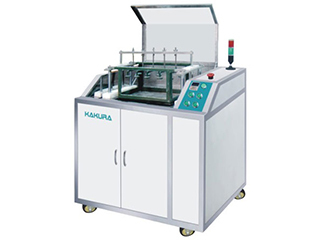
Problem two, transducer detachment. It is understood that most manufacturers use adhesive to fix the transducer, but ultrasonic cleaning machines may experience delamination due to oscillation after long-term use. Some manufacturers also use the method of bonding and tightening with screws, which generally does not result in delamination because of the function of the screws, and the oscillator will not fall off the oscillation surface after delamination.
The general method to determine whether the transducer has come loose is to gently shake the tail of the oscillator by hand and carefully observe the condition of the adhesive on the oscillating surface to make a judgment.
Question 3: The oscillator has come loose. After the detachment of the oscillator, the output power of the ultrasonic power supply is still normal. However, due to poor connection between the oscillator and the oscillation surface, the oscillation effect of the oscillation surface is not good. In the long run, because the energy cannot be released, it is likely to burn out the oscillator.
The industry indicates that the detachment of the oscillator is relatively difficult for users to repair, and in general, it can only be sent back to the manufacturer for repair. The effective way to prevent the detachment of the oscillator is to pay attention not to collide with the oscillating surface during normal use.
Question 4: Perforation of oscillation surface. It is reported that after several years of full load operation, ultrasonic transducers may experience perforation of the oscillation surface, which is caused by long-term high-frequency oscillation fatigue of the stainless steel plate on the oscillation surface. Perforation of the oscillation surface indicates that the service life of the transducer has reached its end, and repair generally only requires replacement.
Article source: Kaiping ultrasonic cleaning machine http://www.kpzfcsb.com/
-
04-01
Jiangmen Ultrasonic Cleaning Machine: What are the reasons for poor cleaning effect?
People originally use ultrasonic cleaning machines for convenience, and if ultrasonic cleaning is not clean, they will definitely feel sad in their hearts. What is the reason for the uncleanliness of
-
01-04
Cleaning process of ultrasonic cleaning machine
Cleaning processSelect a reasonable ultrasonic cleaning machine process based on the characteristics and contamination of the workpiece.4. How to choose between manual and semi-automaticManual operati
-
12-16
Instructions for using Jiangmen ultrasonic cleaning machine
1. Device ultrasonic cleaning machinePlease refer to the instruction manual of the ultrasonic cleaning machine to connect the temperature control sensor signal line, ultrasonic drive line, heater cont
-
12-10
Cavitation phenomenon of Jiangmen ultrasonic cleaning machine
Magical cavitation phenomenonWhen it comes to ultrasonic cleaning, some people may think that it is the use of high-frequency vibration of ultrasonic waves to destroy dust and dirt. Actually, ultrason