
Kaiping ultrasonic cleaning machine explains its development in the electroplating industry
In electroplating, the intention of pre-treatment is to remove dirt and impurities from the surface of the workpiece, making it a suitable active surface for electroplating. The main reason for poor electroplating quality is poor pre-treatment. And the pre-treatment is not good, mostly without using ultrasonic cleaning equipment.
It is necessary to select suitable methods for effective cleaning based on the actual situation of the workpiece during pre electroplating disposal. Metal substrates are generally divided into stamped parts and die cast parts. The oil stains on the stamping parts are generally stamping oil, which is relatively easy to clean due to its high density. Generally, acid washing, electrolysis, etc. can be used. Die castings made of zinc, aluminum, copper, and other materials are relatively difficult to clean due to the addition of various elements. In addition, it is necessary to use various oils such as engine oil and polishing oil during the forming, pulling, rolling, cutting, and polishing processes.
Regarding ultrasonic cleaning machines, the engine oil can be easily removed. But polishing oil is divided into butter white oil, green oil, etc., which is relatively difficult to remove. Therefore, it is necessary to select suitable ultrasonic cleaning equipment and cleaning solution.
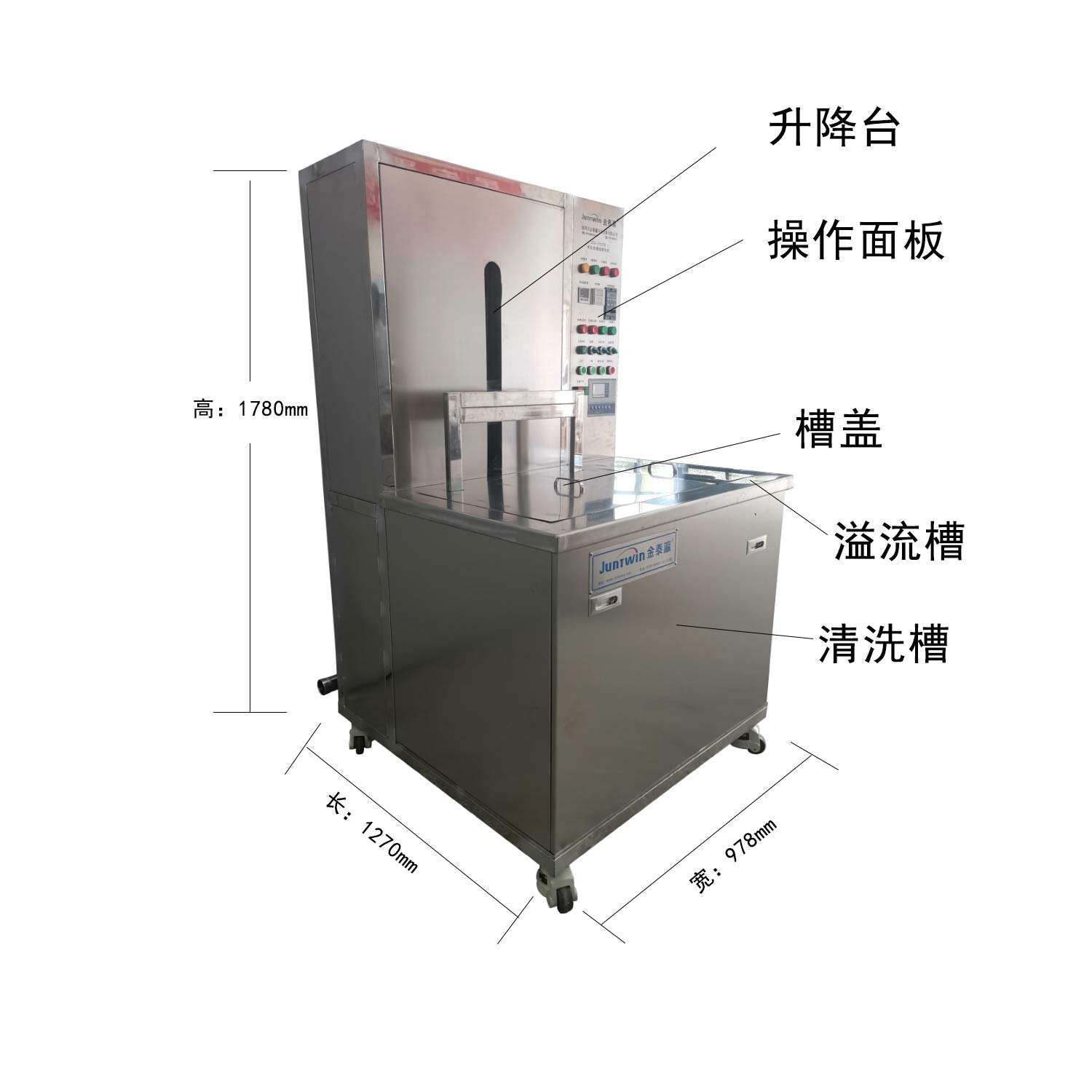
The ultrasound frequency is generally between 20-100KHZ. For the pre-treatment of general workpieces, low-frequency and medium power ultrasonic cleaning equipment is generally selected, such as frequency 25-28KHZ and power density of 1W/cm.
Due to the fact that low-frequency is more prone to cavitation in the medium than high-frequency, ultrasonic cleaning machines can meet the requirements for workpieces with simple and not very fine shapes. The characteristic is that the noise is loud and the price is cheap. For some high-precision workpieces, high-frequency 40-68KHZ high-power ultrasonic cleaning machines are generally used. Therefore, class cleaning machines have better cleaning effects on workpieces with irregular surface shapes such as gaps, clearances, deep holes, blind holes, etc. However, the effect of ultrasonic cleaning can only be achieved where the solution reaches. That is to say, it is necessary to prevent air from entering deep and blind holes, and to pay attention to the phenomenon of impurities falling, oil stains floating, and inadequate cleaning.
Article source: Kaiping ultrasonic cleaning machine http://www.kpzfcsb.com/
-
04-01
Jiangmen Ultrasonic Cleaning Machine: What are the reasons for poor cleaning effect?
People originally use ultrasonic cleaning machines for convenience, and if ultrasonic cleaning is not clean, they will definitely feel sad in their hearts. What is the reason for the uncleanliness of
-
01-04
Cleaning process of ultrasonic cleaning machine
Cleaning processSelect a reasonable ultrasonic cleaning machine process based on the characteristics and contamination of the workpiece.4. How to choose between manual and semi-automaticManual operati
-
12-16
Instructions for using Jiangmen ultrasonic cleaning machine
1. Device ultrasonic cleaning machinePlease refer to the instruction manual of the ultrasonic cleaning machine to connect the temperature control sensor signal line, ultrasonic drive line, heater cont
-
12-10
Cavitation phenomenon of Jiangmen ultrasonic cleaning machine
Magical cavitation phenomenonWhen it comes to ultrasonic cleaning, some people may think that it is the use of high-frequency vibration of ultrasonic waves to destroy dust and dirt. Actually, ultrason