
The mechanism and influencing factors of Kaiping ultrasonic cleaning machine
The mechanism and influencing factors of ultrasonic cleaning
Ultrasonic cavitation
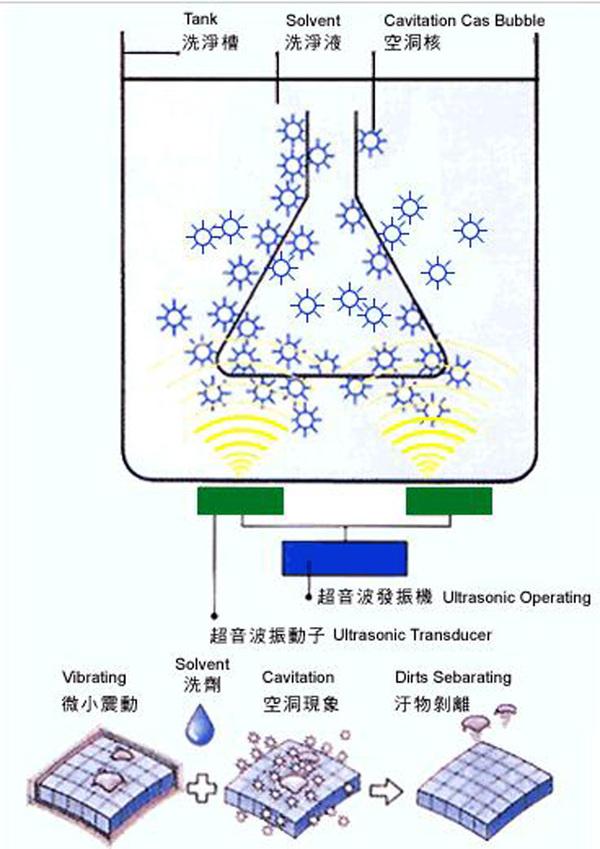
When ultrasound is transmitted in the cleaning solution, physical effects such as cavitation, radiation pressure, and acoustic flow occur, which have a mechanical peeling effect on the dirt and can promote the chemical reaction between the cleaning solution and the dirt. Among them, cavitation plays a primary role in ultrasonic cleaning.
When sound waves are transmitted in a liquid, there exists a replacement sound pressure for each particle in the liquid. When the sound pressure is positive, the liquid is compressed; When the sound pressure is negative, the liquid is stretched. If the tensile force exceeds the tensile strength of the liquid, the liquid will break and form bubbles, which is called cavitation. The minimum sound pressure required to excite cavitation is called cavitation network. After the generation of bubbles, they can undergo vibrational motion or even closure motion under the influence of sound field. When closed, a local high pressure of up to several thousand atmospheres can occur (the result of analysis and calculation under microscopic conditions).
The mechanism of ultrasonic cleaning
The primary mechanism of ultrasonic cleaning machine is to use "ultrasonic cavitation" with a frequency of 20-80kHz. Commonly used is 20-25kHz. Use water, weak acid, and weak alkali as cleaning media, and maintain the operating temperature at 60-70 ℃. Due to cavitation, the liquid undergoes induced effects such as stirring under the action of high-speed micro jets, causing metal compounds and organic pollutants in the oxide layer on the surface of the steel wire to instantly fall off the surface of the steel wire. Because the metal oxides or compounds in the oxide layer on the surface of the steel wire are often finely attached to the surface, in order to achieve the desired cleanliness of the steel wire surface within seconds, low concentration weak acid solutions or alkaline solutions are used as cleaning media to dissolve the metal oxides and organic compounds through chemical reactions. The organic combination of ultrasonic cleaning and chemical cleaning forms ultrasonic chemical cleaning, which enhances the cleaning effect.
Factors affecting ultrasonic cleaning power
sound intensity
Above the cavitation level, the louder the sound intensity, the more intense the cavitation. But after the sound intensity reaches a certain value, cavitation tends to saturate, and if power is added, the cavitation intensity actually decreases. In addition, under high sound intensity conditions, the radiation surface of the transducer and the surface of the washed object are prone to cavitation corrosion, therefore, it is required that the power selection be moderate.
frequency
The relationship between sound intensity and frequency required for cavitation in water is shown in Figure 1. As shown in Figure 1, the lower the frequency, the easier cavitation occurs. At low frequencies, the compression and scarcity time is longer, that is, the liquid is compressed and stretched for a longer period of time. Therefore, the growth time of bubbles is also long and their volume is relatively large. The size of the impact force generated when the cavitation bubble closes is directly proportional to the size of the cavitation bubble, so the frequency of ultrasonic cleaning in product production is selected to be 20-25kHz. In addition, it can be seen from Figure 1 that the cavitation reading of water containing gas is lower than that of water without gas, and the presence of gas in the cleaning medium can reduce the ultrasonic power.
Sound field dispersion
Research has shown that a stable standing wave field in liquid is the best condition for cavitation. When a standing wave field is formed in a liquid, the intensity of cavitation is unevenly distributed. Place the aluminum foil in a 40kHz cleaning tank and observe the pattern of cavitation punching holes on the aluminum foil, as shown in Figure 2. Areas with high corrosion on aluminum foil indicate strong cavitation. Aluminum foil is severely corroded every 19.1mm, which corresponds to the half wavelength transmitted by 40kHz ultrasonic waves in water (aluminum foil is vertically placed at the center of the cleaning tank). Therefore, when designing the cleaning tank, it is reasonable to treat the wire routing height at 12/of the corresponding frequency wavelength.
wave form
The generation of ultrasound is a process of electroacoustic conversion. Electronic circuits convert AC power at 50Hz frequency into high-frequency vibration current (20-25kHz), which is amplified by a power amplifier to form the so-called "ultrasonic generator". Mechanical vibration occurs when high-frequency power is loaded onto the transducer. Modern ultrasonic generators use "Class D amplifier" circuits for power expansion, and operate in a switch state, so their output is a rectangular wave. The power output of rectangular wave reaches over%, which is better than that of sine wave. Therefore, the frequency change scale increases and the cleaning effect improves.
temperature
Temperature affects the cavitation intensity and the rate of chemical reactions during cleaning. There is a suitable temperature for the maximum cavitation intensity corresponding to different liquid media. However, when ultrasound acts on the medium, a portion of the energy is often converted into heat, causing a natural increase in the temperature of the cleaning medium, so external heating is generally not required. Because the action of the circulation pump enables the temperature of the medium to be balanced.
External tension and drilling hysteresis of the medium
The greater the surface tension of the cleaning solution, the higher the cavitation intensity. But too much external tension will prevent the formation of cavitation. The influence of viscosity on cavitation intensity is manifested as follows: the greater the viscosity, the weaker the cavitation intensity, the greater the viscosity, and the greater the energy required to transmit ultrasound. Therefore, when equipping cleaning solutions, additives are used to manipulate the surface tension and viscosity of the cleaning medium. In practical applications, the selection of the above parameters is a very important issue. The selection is primarily based on the type of dirt and the strength of the adhesion between the dirt and the surface being cleaned.
Article source: Kaiping ultrasonic cleaning machine http://www.kpzfcsb.com/
-
04-01
Jiangmen Ultrasonic Cleaning Machine: What are the reasons for poor cleaning effect?
People originally use ultrasonic cleaning machines for convenience, and if ultrasonic cleaning is not clean, they will definitely feel sad in their hearts. What is the reason for the uncleanliness of
-
01-04
Cleaning process of ultrasonic cleaning machine
Cleaning processSelect a reasonable ultrasonic cleaning machine process based on the characteristics and contamination of the workpiece.4. How to choose between manual and semi-automaticManual operati
-
12-16
Instructions for using Jiangmen ultrasonic cleaning machine
1. Device ultrasonic cleaning machinePlease refer to the instruction manual of the ultrasonic cleaning machine to connect the temperature control sensor signal line, ultrasonic drive line, heater cont
-
12-10
Cavitation phenomenon of Jiangmen ultrasonic cleaning machine
Magical cavitation phenomenonWhen it comes to ultrasonic cleaning, some people may think that it is the use of high-frequency vibration of ultrasonic waves to destroy dust and dirt. Actually, ultrason